Thursday, April 5, 2012

Stark Realities Leading to Strategies

In my Anglican ordinand group at Ridley Melbourne this week we talked about what strategies would be necessary to see our diocese grow. We got into it by thinking about the current state of our local churches and their recent growth history. Here are the questions we asked and our answers. (While we were mostly talking about Melbourne, I would be surprised if the answers were markedly different for any diocese.)

1.
How many Melbourne Anglican churches have experienced significant growth in our lifetime?

We could list off around 15. There are probably also a bunch we don't know about so this should be counted as a minimum. Still, even if it were double, that's only 30 local churches out of around 220 in the diocese.

2.
How many Melbourne Anglican churches have experienced significant growth in the past five years?

Here we struggled more and could only count a couple with confidence. Maybe there could be five? Again, out of about 220.

3.
How many Melbourne Anglican churches have experienced significant growth under two consecutive leaders?

For this we thought zero - although again, this might be due to our ignorance. If there are any, it's unlikely to be many.


After this, we moved on to consider what we could learn from these observations that would help our thinking about building the diocese in the future. A few of our thoughts were -

1.
It's important to think about a local church's future potential far more than its existing reputation (although there may be an interplay here).

2.
Under God, growth is at least partially, if not largely, a function of leadership.

3.
Material resources (ie. church buildings, vicarages, income streams, etc.) are not enough.


Of course we discussed the role of circumstance and setting - different types of churches flourish in different places at different times depending on all sorts of social phenomena - and it's absolutely critical to acknowledge the faithful, hard work that's been going on with sowing and watering around the diocese for years, even where lots of fruit hasn't (yet) resulted. But just as it would be wrong to exclude circumstance from our equations, so too would it be wrong to make it the sole factor in our considerations of why different local churches do or don't grow.

In terms of a future plan, our best conclusion was that, as far as anyone could predict (and of course no one can), the most likely strategy to achieve diocesan growth is sending new leaders to non-flagship churches that have potential and then for those leaders to commit to the hard work of building them up over many years. Perhaps the most plausible positive vision for the future won't focus on those few churches in the 500+ club growing larger, but on seeing more smaller churches growing to that size.

So, God's strength to the young leaders who have taken on leadership of smaller parishes in the past few years!

___

One factor that I'd love to be able to measure in local churches is prayerfulness. It was put to me a while ago that revivals are always preceded by prayer - proper, persistent, humble, long-suffering prayer. While I suspect few, if any, local Anglican churches could be accused of being completely prayerless, it could be very interesting to explore the different patterns of prayer in different churches. I reckon we'd learn a lot from that too.

Friday, March 16, 2012

Archbishop of Canterbury Stepping Down

The BBC is reporting that the Archbishop of Canterbury, Dr Rowan Williams, will step down from his position in December. He is only 61 and isn't retiring but moving on to an academic post at Cambridge. So, one question is, Why now?

But perhaps the bigger one is, Who next?

Given the current issues within the Anglican Communion, the appointment of the 105th Archbishop of Canterbury will be very significant. The Communion's fabric has already begun to tear - will the next appointment slow that down or speed it up? And what does the Anglican world want anyway?

Lots of thoughts to think and things to watch over the months ahead...


Friday, March 9, 2012

Future Leaders - Appreciation and Issues

This semester I'm helping out at Ridley Melbourne by meeting weekly with a group of Anglican ordinands. To kick our group off, I asked them three questions. Here they are with the group's responses -

1. Why are you putting yourself forward for Anglican service?

  • The 39 Articles make a good confession.
  • The episcopal and parochial structure of the Anglican Church provides a good mix of support and autonomy.
  • It's a good ministry platform - there's investment in leaders and church-planting opportunities.
  • Its unique mission opportunity - the parish system covers the world.
  • A personal history in the Anglican Church.
  • It accommodates different personal styles of ministry.
  • It has solid foundations.
  • It accommodates some breadth.
  • There is theological balance and tolerance.
  • Great cross-cultural potential.
  • Commitment to global fellowship and service.
  • Strong stream of scholarship and solid theologians.
  • Equivalence of ordination.
  • Liturgy - its order and comprehensiveness.
  • Training and succession planning.
  • Its beauty - in theology and structure.
  • Concern for social justice.


2. What questions do you have for / about the Anglican Church?

  • How do I participate in synod?
  • What are the not-negotiables?
  • How are bishops made?
  • How are councils / committees / etc constituted?
  • How does church planting / repotting work?
  • What direction is the Anglican Church heading?
  • What's the story with GAFCON, TEC, ACNA, etc?
  • What is canon law?
  • How does the Province of Australia work?
  • What do Anglicans believe about 'reserved sacrament'?
  • Will a woman get the same opportunities as a man to serve? What arrangements are in place for maternity leave, etc?


3. What concerns do you have about the Anglican Church?

  • The confrontational nature of synod.
  • Disagreement over the basics.
  • Lack of discipline.
  • Some limits on the possibilities for working in different cultural contexts.
  • Bureaucracy.
  • The need to submit to bishops.
  • Dry traditionalism.
  • Ineffectiveness of remote, top-down leadership.
  • Capacity to manage resources.
  • It's a boys' club.


I was encouraged by the great list of positive reasons for wanting to serve as an Anglican and by the honesty around the questions and issues raised.

The plan is to see how much of 2. and 3. we can nut through in our time together.


Friday, March 2, 2012

Sad but Inevitable...

So it's now been confirmed that Christchurch Cathedral will be demolished. I know it's only a building and I know that nothing like this was built for eternity and I don't believe in 'sacred space' in a superstitious way - but it really was a great landmark for the city and it's sad that its time is up. I've also spent a lot of time in Christchurch so feel some personal nostalgia.

Here's a couple of pics from 2005 when the British Lions were touring in New Zealand.


This has also got to be disheartening for the people of the city. Someone told me that Christchurch has lost one third of its residents since the quake last year and that the CBD is still in lock down and under military guard. That's gotta hurt the community vibe.

For those who pray for cities, remember this one.


Thursday, March 1, 2012

A Well-Reformed Church

The thoroughness of the official reforms to the Church of England under Edward is impressive. Christopher Haigh - a revisionist historian who's not himself a fan of Protestantism and therefore has nothing much to gain by pointing all this out - says:


The Homilies taught justification by faith; the Injunctions forbade images; the Chantries Act denied the efficacy of prayers for the dead; the 1549 Prayer Book put the mass into ambiguous English; the 1550 Ordinal turned a sacramental priesthood into a preaching ministry, and for emphasis the altars were taken down; in 1552 the Church was given a Protestant liturgy, and in 1553 a Protestant theology – as Edward lay dying, the old vestments and service equipment were being confiscated from parish churches.

Sure, there's more to the story; Elizabeth's program was somewhat different to Edward's and lots has happened since the Tudors. But let's be clear, we still have essentially the same Prayer Book, the same Ordinal and the same Articles - we're very much the product of the Edwardian reforms.

Praise God for his Reformed Anglican Church!

Monday, February 13, 2012

Who Does What - Corrections

AJ offered a helpful corrective in a comment on my post on Parish Councils / Vestries. Therefore I've gone back and corrected it and also fixed my post on some of the other formal roles in local Anglican churches.

Hopefully these are more correct and more useful now.

Wednesday, February 8, 2012

The Whole Counsel of God

I've been preparing some material about preaching systematically through the Scriptures for an upcoming seminar. This has been my practice in congregational ministry but it's been really good for me to step back and break down the factors that need to be considered and the challenges and implications of working this way.

It strikes me that while lots of evangelical Anglican churches are committed to biblical preaching, they're not always as practically committed to preaching their way through whole books of the Bible, nor to preaching a good balance of all the parts of the Bible. (How many churches can I think of that have preached through all of Ezekiel lately... ? To be honest, how many churches can I think of that have preached through all of John's Gospel lately!) But if we're meant to feed the flock with every word then we've got to tackle this.

Of course, traditionally, Anglicans have followed a lectionary - and many still do. And while it can be very easy to criticise set lectionaries (because they usually skip lots of texts), I do wonder if they actually do a better overall job of systematically bringing the whole Bible to congregations than we often do if we don't use them.

I would be very keen to see a lectionary that gave the whole Scripture divided into sensible blocks and mapped out in some sensible sort of way to account for the seasons of the year and so on. Anybody know of such a thing?

Monday, January 30, 2012

Killing the Resurrection?

I've been reading from 'The Structure of Resurrection Belief' by Peter Carnley, former Archbishop of Perth and Primate of the Anglican Church of Australia. In it he upholds the possibility that the biblical accounts of the risen Jesus were actually 'heavenly visions' and he refuses to affirm the classic view of Jesus' bodily resurrection. It appears to me that Carnley believes in some sort of resurrection, but while he helpfully pushes past simplistic 'back to how he was before he died' thinking and points to the transformation that Paul speaks of in 1 Cor 15, he seems reluctant to own the fact of there being a real physical dimension to Jesus' resurrection (though I have to admit to not having read the entire book at this stage so perhaps he does somewhere).

Carnley's work has been discredited - not least by N.T. Wright who takes him to task in the opening of the magisterial 'Resurrection of the Son of God' - and its easy to point at places where has a low view of the authority of Scripture (and of the Bible writers themselves, eg. Luke inventing more material resurrection appearances so as to put himself a step above Paul). But on top of all this, its so sad that while he seems well-intentioned in much of what he writes, when it comes to discussing the beliefs of 'conservatives' in the church, he becomes more prickly such that its not just his views, but also his tone that is disappointing. (His more recent Reflections in Glass: Trends and Tensions in the Contemporary Anglican Church, is just plain tedious in its now standard liberal caricaturing of 'Sydney Anglicans'.)

Not only does he fail to promote orthodox, historical Christian teaching (what is 'progressive orthodoxy' anyway?), but by making his ambiguous views public, Carnley also makes it more difficult for members of local Anglican churches to give a plain account of their hope to any inquiring family members, friends, neighbours and colleagues. Believers are already perceived as fools in the eyes of the world for the straightforward proclamation of Christ crucified and risen. That perception is only compounded when their own church leaders won't promote the message with them!

But Carnley has retired now and I don't think the current Archbishop of Perth nor the current Primate have views akin to his.

Thursday, January 26, 2012

Who Does What 5 - Some Others...

A few more at the local church level...

Church wardens - have the legal responsibility for the local church's finances, property and staff. This means it's their role to ensure that the church's bills are paid on time, church buildings are properly maintained, staff remuneration packages comply with employment laws and so on and so on. The great thing about all this is that it serves the whole church by taking so much off the vicar's plate. When people train for ordained ministry through studying at a theological school and serving as curates, their focus tends to be on theology and pastoral studies, not on organisational management. And this is as it should be - pastoring and teaching should be the vicar's priority in the parish. Good wardens, therefore, should complement the vicar's skill set by bringing practical management competencies to the service of the local church.

Nominators - are lay people who are set aside to search out a new vicar / rector when one is required. They often do this in collaboration with an external person assigned by the bishop. Of course, most of the time they do nothing at all, but they must always be in place because no one can ever say for sure how long a vicar will remain at the helm.

Synod representatives - are those members of the local church who have voting rights at the diocesan synod (~parliament). Licensed clergy are usually (although not always) members of synod and then there are a number of elected or appointed lay members too. (There are various extra-parochial people who get onto synod too, but that's a whole other story.)

Umm... I don't really have a great deal of commentary to give on these positions at this stage and there are heaps more that I've left out too - archdeacons, deans, canons, precentors, lay readers, chaplains... But if anyone's especially interested in these (!) they can all be googled. Time for me to wrap this set up and move on I think...

Wednesday, January 25, 2012

Who Does What 4 - Parish Councils / Vestries

So, this one has been some time coming because it's harder to be clear about the role of a parish council or vestry than it is to be clear about clerical roles. I'm also not sure how much commonality there is between dioceses on the roles they assign to vestries so my reflections here are primarily based on the situation in Melbourne. (And I'm still not sure that I've got majorly insightful things to say... )

The Anglican Church has a strong history of lay leadership. In addition to the three orders of clergy, the Church includes lay leadership at a number of levels. Here in Melbourne, for example, the diocesan synod (~parliament) has more lay than clerical members. And each parish church has a council, or vestry, of lay people who are involved in its oversight.

While some local churches view their vestry as the board of governance, this isn't really right. Unlike boards in the corporate world, the vestry has no power to hire or fire the vicar / rector, who is the CEO equivalent, and the vicar actually has the power to appoint some members of the vestry. Also, the vestry has no real authority to direct the vicar / rector in terms of the ministry activities of the church.

The stated purpose of a vestry is to "consult together on matters of general concern and importance to the parish". Therefore, they are best understood as an advisory group for the vicar.

Such a group can be invaluable if they have all been screened on the basis of their Christian maturity and commitment to the parish church before taking up their roles. They can provide the vicar with lots of valuable insights from a range of perspectives. At the most basic level, just drawing on the exposure, experience and wisdom of a group of trusted congregation members will give the vicar a fuller picture of their church than if they just relied on their own.

But just as with other positions in the church, problems are likely to arise if a vestry assumes roles that they shouldn't. If, for example, they treat the vicar like their employee or want to have the final say in ministry decisions, then they've misunderstood their job. This isn't to say they have no recourse if they really believe their vicar is making a mistake - they can always approach their bishop if necessary. But like all roles in church, the clearer a vestry is about what they're meant to do, the more likely they are to be able to offer the most fruitful service.

Monday, January 23, 2012

All Philled Up

In church this week we prayed for our archbishop, Philip, our local bishop, Philip, and our minister, Phil. We really should have prayed for the Primate too.

If only the Archbishop of Canterbury wasn't a Rowan...

Saturday, January 21, 2012

Weird Gift?

What's this in St Paul's Cathedral Melbourne?


Well, as the stonework says, it's a piece of the reredos of St Paul's Cathedral London (look it up!)

But my real question is, Why? I guess it's a nice gesture, but it seems to me a strange thing to give - unless there's some tradition behind gifting reredos parts. Anybody... ?

Anyhoo, next time I get to St Paul's in London, I'm going to look for the missing bit.

Thursday, January 19, 2012

Functional vs Ontological


Picking up on a question in an earlier post, here are a couple of thoughts on what exactly Anglican ordination is.

Basically, the views fall between two extremes. At the one end is the idea that ordination is purely functional such that getting ordained is a bit like getting, say, your pilot's licence. You need one to fly but it's no more than a mark of recognition that you've proven yourself able to fly, that you choose to be an active pilot and that the authorities are happy to accept you. There's no way in the world that just issuing a licence gives you your flying skills and there's no reason to hold a licence once your active flying career is over.

At the other extreme is the idea that when you're ordained, God affects an ontological change in the very nature of who you are. You become a different kind of person at the point of ordination. This is why when you stop working as a deacon, priest or bishop, you're still recognised as one in title and why some retired ministers still wear their clerical garb. They see themselves as part of a distinct and enduring group of believers even once they no longer have any official roles in the church.

I sit much closer to the first view than the second, however, I think the extreme position does go too far. The reality is that even if there's not an immediate supernatural transformation, there's certainly at least a social transformation that takes place when a person is ordained. There are appropriate whole-of-life expectations for ministers such that they cannot ever switch off from their role in the same way that a pilot can when they're not flying. And even once they've retired from a position, a failure to live up to their ordination vows can have significant impact on those that the clergy have previously ministered to in a way that a pilot's post-flight behaviour doesn't affect their previous passengers.

Like many arguments by extreme, while positions can be clarified by looking at the end-points, the reality can also be distorted by the terms of the analysis. Recognising this, it's also good to clarify the various ways that people use their language on this topic too, because while there are some significantly different views, there are also some that we might assume are more to one extreme than they really are. For comparison, consider the fact that ex-presidents of the US are still referred to as 'President'. This honourary use of the title in no way reflects anyone's beliefs about the reality - the US only has one president at a time - and given that so much is clear, the use of the title doesn't risk transmitting a dangerously distorted understanding of the Constitution. I suspect that some who attribute clerical titles to people who are no longer working for the church have a similar perspective on it.

It is worth noting that even when a retired minister does still carry their title, that doesn't automatically mean they can continue to perform specific ministerial duties. All clergy need a licence from their bishop or archbishop to be active in clerical ministry. So, while they still might be able to wear the collar, they cannot do things like perform weddings, preside at holy communion or ordain lay people (in the case of retired bishops) apart from a current licence. Any ontological change that occurred at ordination still needs permission to be functionally active.

Wednesday, January 18, 2012

Anglicans and Arabs on TV

I had the privilege of meeting the Most Rev Dr Mouneer Hanna Anis yesterday. He's the Anglican President Bishop of Jerusalem & the Middle East and Bishop in Egypt with North Africa and the Horn of Africa.


Tomorrow morning (Jan 19th) at 8.10am (AEDT) he's going to give a live TV interview on the Arab Spring on ABC One and ABC 24 here in Australia.


Will be interesting to hear his perspective on it all.

Thursday, January 12, 2012

Private Confirmation

Well, not really private, just small.

My wife was confirmed as an Anglican today by our bishop in bit of an odd service at St Paul's Cathedral.

It was odd only in the sense that she was converted and baptised as an adult and so has already made an open and public declaration of faith - confirmation is meant to give people who were baptised as infants the chance to do that.

So why did she bother? It's a necessary prerequisite for her entering the 'Year of Discernment' which is the year-long program that the Melbourne Diocese runs for people who are considering becoming candidates for ordination. Dovetailing neatly with yesterday's post, my wife is exploring the possibility of becoming a distinctive deacon as part of our plan to continue working alongside each other in Anglican ministry.

It was actually a pretty good little service. Like lots of the liturgy, the words are really great and the bits the candidate has to say are things that any follower of Jesus would want to say. We also read through Mark 1:40-45 and talked about it together. And it was really great to share the service with the guy in the picture who was being officially 'received' into the Anglican Communion so that he can take up a formal leadership post at his church and with our minister who made the trek into the Cathedral to be there with us.

Now my daughter - who was baptised as an infant - is asking about when she can get confirmed too!

Wednesday, January 11, 2012

Who Does What 3 - Deacons

Unlike bishops and priests, there are no specific tasks for deacons, although they are often thought of as having ministries that focus on serving the poor and marginalised or those at the fringe of the church. In the Anglican world, deacons can't do the 'ABC' of absolution, blessing and communion and therefore can't be appointed as parish vicars / rectors. While this could be seen as a limitation, it's better thought of as a freedom to stay focussed on other front-line ministries.

The go-to New Testament passages on deacons show us that they were first formally appointed to take on the work of food distribution so that the apostles could focus their energies on word ministries and prayer (Acts 6:1-6). And even though their task was very practical, it was imperative that those chosen had Spirit-shaped character (Acts 6:3, cf. 1 Timothy 3:8-13). But of course, as the story unfolds in Acts, we find that at least two of the deacons become powerful testifiers to the gospel of Jesus (Acts 7-8, 21:8), so there ends up being some significant overlap of their work and the apostles'. This is comparable to the overlap between the work of Anglican deacons and priests.

As I keep thinking about the diaconate, my question is, Why don't Anglicans ordain more people who work in churches as deacons? Here in Melbourne, we have many non-ordained church workers who are licensed by the Archbishop as 'Authorised Lay Ministers'. Why not make them deacons?

Reasons might include that some Anglicans believe that a person needs to be 'called' to ordained ministry and that when they are ordained, they are 'ontologically' changed. Therefore, ordination is more than just functional and more than just a practical recognition of the work someone does in a church. I'm not sure that I find this a particularly convincing argument. On the one hand, there's not much solid biblical evidence for it and on the other, it would seem strange to have lower expectations of an Authorised Lay Minister than a deacon if they were doing the same job.

Recruitment and training have become practical distinctions. That is, while the vicar of a local church can employ anyone they see fit, a deacon needs to have been through a diocese's program of formation. Perhaps this means that a deacon's suitability to their role is more broadly recognised than a lay minister's.

In the Diocese of Melbourne, there are very few distinctive deacons (as opposed to 'transitional' deacons who are moving towards becoming priests). By comparison, Sydney Diocese, with its more functional view of ministry, has been proactively reviving its diaconate over the past few years and so has a few more. Interestingly, these dioceses also have different stances on the ordination of women to the priesthood and this may affect their relative numbers of deacons. Melbourne accepts female priests and Sydney doesn't so in Sydney, all ordained women are deacons.

This leads to another good point to make when thinking about deacons which is that all clergy are deacons. That is to say that when a deacon is ordained priest, they don't stop being a deacon. I think this is great because it reminds the clergy that no matter how high up the organisational chart they might climb, they must always remain servants of others. Right in line with Jesus' teaching in Mark 10:35-45.

Tuesday, January 10, 2012

Who Does What 2 - Priests

Lots of Christians don't really like using the term 'priest' for church leaders anymore. This is because of the Old Testament connotations where the priesthood can appear largely ritualistic, the fact that the New Testament talks about the 'priesthood of all believers' (cf. 1 Peter 2:9 - although I am aware that the common interpretation of the phrase 'royal priesthood' is far from universally accepted) and just because of the current connotations of the word 'priest' - we tend to think of an old man who is either exceedingly soft and cuddly or else quite rigid and grumpy. The Anglican Diocese of Sydney has even begun using the non-translation 'presbyter' instead of 'priest' which is fine at one level, although if the aim was to avoid confusion, I'm not sure it's achieved all that much.

In the Anglican Church, ordained 'priests' are those people given authority to preach and administer the sacraments and whose general duties include leading and pastorally caring for a local church. I say 'general' duties, because there are actually lots of other ways that priests can be deployed. For example, they can be assistants to the head priest in a parish (the vicar or rector), chaplains in a wide range of contexts or workers in parachurch organisations. But even when a priest isn't a vicar / rector, it's still expected that they have all the qualifications and have met all the requirements for that 'standard' priestly role. This goes back in part to the idea of equivalence of ordination throughout the worldwide Anglican Communion.

One thing that I find really disappointing is that many priests give only a small amount of energy to their bread-and-butter work of preaching, presiding and pastoring. It would be easy to just highlight the five minute sermonettes that are offered in some liberal parishes or the infrequency of (and sometimes near-irreverent attitude towards) communion in some evangelical parishes, but the problem goes beyond these. So many parish priests these days find themselves so tied up in governance, management and administration tasks that time for sermon preparation and pastoral meetings seems to just get squeezed out. In many cases, this is genuinely grieved as priests long to get free of their ever-growing list of additional duties and to get on with the work they entered the priesthood to do. But there are others who I fear have forgotten their first charge and embraced an altogether different model of priestly leadership that isn't centred on pulpit and parishioners.

So what to do? The first thing is just to recognise the different roles that different members of the church are meant to fulfil and then to ensure that each person is focussing on the right thing. John Stott addressed exactly this issue in his chapter 'Ministry: The Twelve and the Seven' in one of his final books, 'The Living Church' (which is very worthwhile reading).

After this, priests then just need to employ the disciplines necessary for them to prioritise the priorities. A great example for me is a priest I know who simply set a firm time-limit on how much administration he would do during the week. Once the time was up, it was up and if some things didn't get done, they didn't get done. He had made a decision that he wasn't going to let management tasks impinge on the time that he committed to preparing sermons. He was an Anglican priest practically committed to doing the work of a priest.

Monday, January 9, 2012

Who Does What 1 - Bishops

Spinning off from the earlier posts on competence, I thought it would be worth putting up a couple of posts considering how the Anglican Church understands the roles of different people within it. No doubt, this will be far from exhaustive and there will be lots of alternative perspectives out there, but let's see how we go...

So, bishops.

The Anglican Church believes the Bible teaches that there are three layers of church leadership: bishops, priests and deacons (= episkopoi, presbyteroi, diakonoi in the original Greek of the New Testament). This is disputed by some who think that that episkopoi and presbyteroi are two words for people in the same roles.

Bishops then sit at the top of the hierarchy of ordained people and have oversight of the parish churches and clergy of a given region called a diocese, which itself has a central diocesan church - the cathedral. Large dioceses can have several bishops although the archbishop is the one who holds final authority while the others are his assistant (or, depending on the particular diocese, coadjutor or suffragan) bishops.

Bishops' functions are mostly ceremonial and administrative. Although some take on the 'pastor of pastors' role, many clergy now have mentors who are not part of the formal structure of the church. And because bishops don't have direct congregational oversight or hold a regular pulpit, I've heard it suggested (by someone who I think holds more to the idea of a two-fold order of leadership) that Anglican bishops should really be re-designated as deacons.

Getting beyond structures and definitions however, the most important parts of a bishop's role are the making, hiring and firing of clergy and the upholding of doctrinal standards. In the Anglican Church, a lay person cannot be made a deacon, nor a deacon a priest, apart from a bishop's ordination. Three bishops are required to consecrate a priest as a bishop. No clergyperson can have an active Anglican ministry in a diocese without being granted a licence by its bishop or archbishop. So, while the average punter may not ever receive much teaching or pastoral care from their diocesan bishop (they could actually probably go along happily for quite a long time without ever seeing them or even knowing their name!), nonetheless, their bishop has an enormously large impact on the local church through the clergy that they licence to serve there.

Biblically, we might say that Titus is an example of someone with this bishop's role of appointing leaders for a region and guarding doctrine. He was instructed by Paul to "appoint leaders in every town" (Titus 1:5) and to choose people who would, among other things, "be able to both preach with sound doctrine and to refute those who contradict it" (Titus 1:9). Unlike most Anglican bishops though, we see as we read through Paul's letter that Titus also seems to have had an active pastoral ministry of his own.

Sunday, January 8, 2012

American Encouragement

It was an unexpected pleasure to have one of the world's foremost authorities on Anglicanism turn up at our church today (although actually not so unexpected given that his son and daughter-in-law are members of the congregation) and a fantastic opportunity for me to be able to chat for a while.

But apart from the chance to test a few ideas and pick up a bunch of great research leads, I was really encouraged by the news that in the USA - where he lectures theology - there's a significant number of young leaders heading into the Anglican Church. Apparently, one of the big reasons for this is that many of them are seeing some of the problems of those churches that don't have a formal liturgy. And interestingly, one serious shortcoming is felt to be that those churches don't really allow for much congregational participation in the Sunday services - singing and putting money in the collection plate is often about it. On the other hand, the liturgical churches are recognised as encouraging members to be involved at several points; saying creeds, confessing sins, leading prayers, etc. And so for those people who want to lead churches with more of this kind of congregational involvement and who aren't Catholic, the Anglian Church turns out looking pretty good.

I really wouldn't have guessed any of this, but there you have it. God is working in significant ways in new generations in the Anglican Church - even in North America.

Saturday, January 7, 2012

Brilliant Wedding!

Today we really enjoyed celebrating the wedding of a couple from our old church, and for a few different reasons.

Firstly, it was really Jesus-honouring. Not only is the modern Anglican wedding service great in itself (it was Second Order APBA), but with the extra Bible readings that the couple asked for and what was said in the speeches, the goodness of God and their joy in him was made powerfully clear.

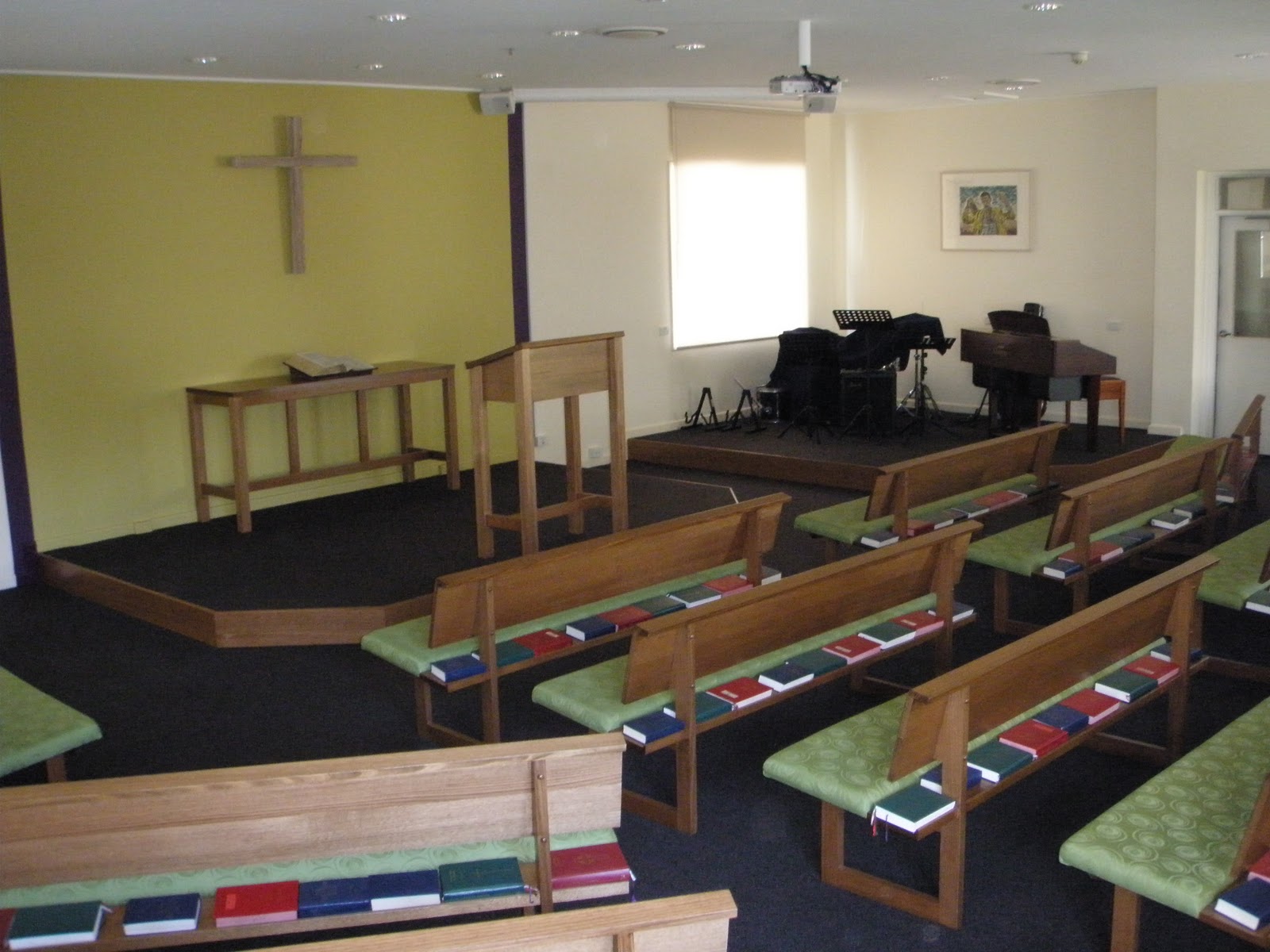
Then there was the minor but nice historical fact that it was the first wedding held in the new chapel at Ridley Melbourne.

Next was the truly brilliant wedding gift. The couple had asked that instead of giving them presents, everyone chip in to a Village Package through TEAR. At the reception we heard about the particular village in Bengal, India that had been supported by today's guests. It's amazing the huge good that a relatively small group of financially secure Westerners can do when they pool together. (In the same vein, the bomboniere were packets of FairTrade coffee and chocolate from Tribes and Nations.)

Then there was the food at the reception. A five star buffet.

And finally, the music at the reception was awesome. Just a drummer and bass guitarist, but they produced a really full, very hip sound. Check out the Two Quriks Facebook page for free downloads!